Copergrine

For providers

License the platform Copergrine uses internally.

The same integrated EMR, telehealth, billing, and patient messaging stack that powers our wellness clinic and telehealth visits — with an ambient AI scribe, 74,000+ ICD-10 codes, and built-in evidence-based treatment plans.

Built for solo providers · group practices · health systems
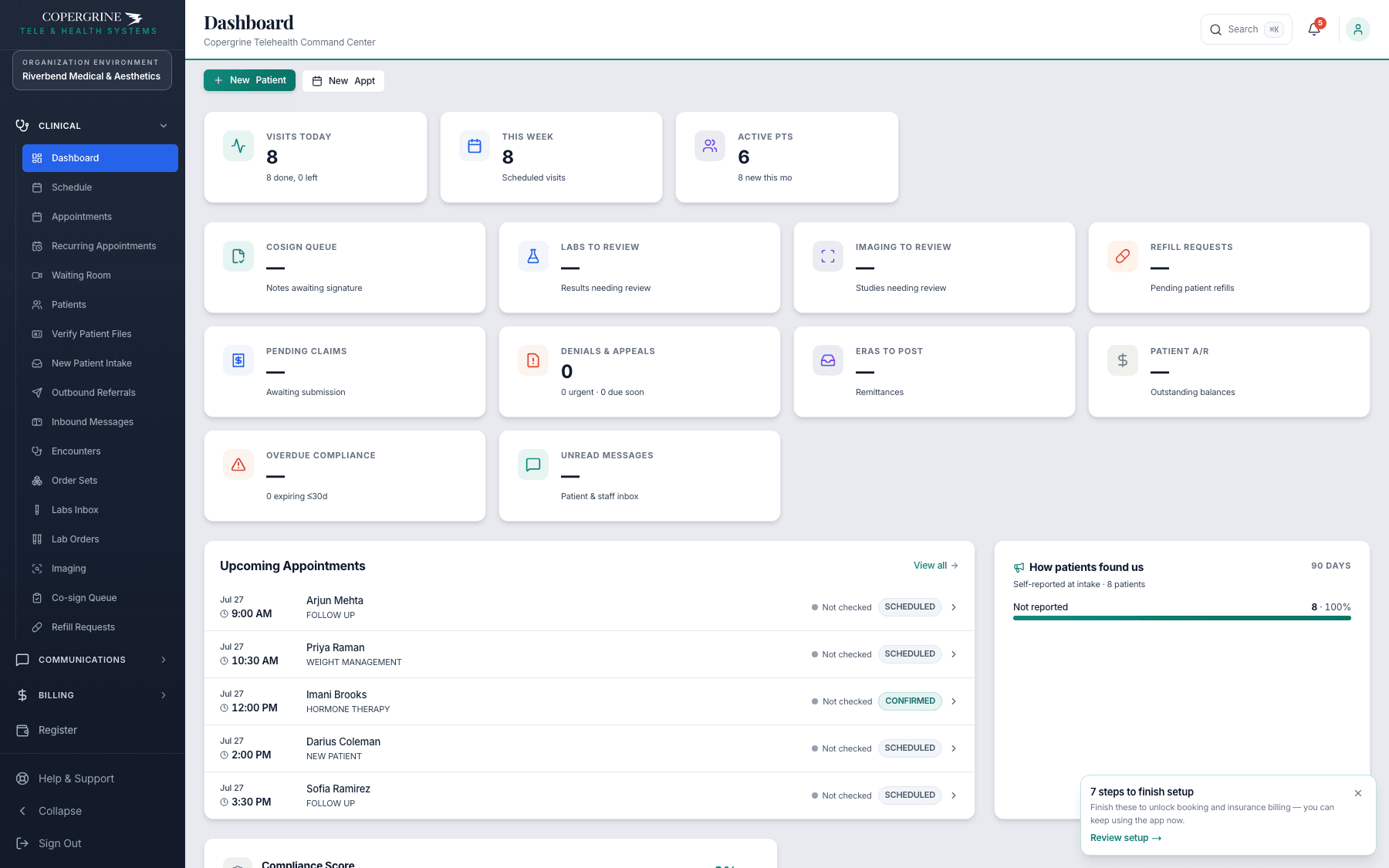
Copergrine Telehealth provider dashboard with upcoming appointments and referral sources

One platform, six surfaces

Stop stitching six vendors together.

Charting, scheduling, e-prescribing, billing, patient messaging, and AI documentation — all under one HIPAA-compliant platform Copergrine runs and operates end to end.

Charting

Subjective, objective, assessment, plan — with templates and macros built for actual clinical workflows.

Scheduling

Online booking, in-person + telehealth, automatic reminders, and double-booking guardrails.

E-prescribing

Send to any accredited pharmacy nationwide, with full EPCS compliance for controlled substances.

Billing & claims

Eligibility verification, claim submission, ERA processing, and patient billing — built in.

Patient portal

Secure messaging, lab results, visit history, and HIPAA-compliant push notifications across iOS, Android, and desktop.

Ambient AI scribe

The scribe drafts your note while you talk. ICD-10 + CPT codes auto-suggested. You sign and lock.

01 · Dashboard

Walk in, see your day in five seconds.

Visits today, weekly target, referral sources, and your AI agent task queue — all on one screen the moment you log in. No more hunting for what needs your attention.
  • Live visit count + remaining appointments
  • Referral attribution by channel (SEO, ads, AI agents, word-of-mouth)
  • Compliance score across HIPAA + practice checks
  • Agent task queue: intake, scheduling, documentation, billing
Copergrine Telehealth dashboard showing 8 visits today, 24 this week, referral sources, and agent task queue
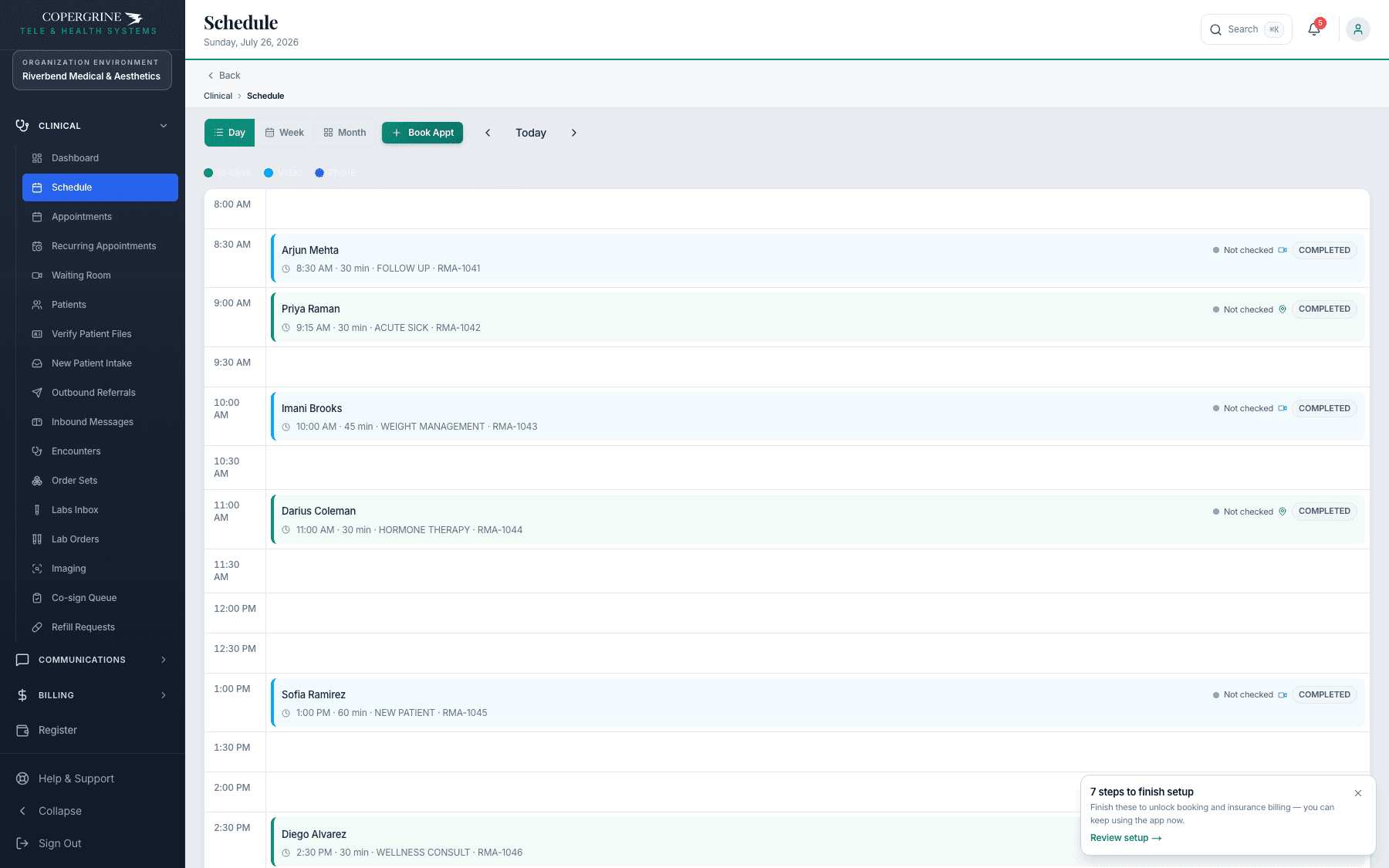
Schedule view for Wednesday April 8 with eight appointments mixing in-person and telehealth visits

02 · Schedule

Book, reschedule, route — one screen.

In-person and telehealth on the same calendar. Color-coded by visit type. Smart guardrails prevent double-booking and missed prep windows.

  • In-person + telehealth on a unified day view
  • Drag to reschedule, click to launch the visit
  • Automatic reminders via PWA push and email
  • Intake form auto-sent before each appointment

03 · Patients

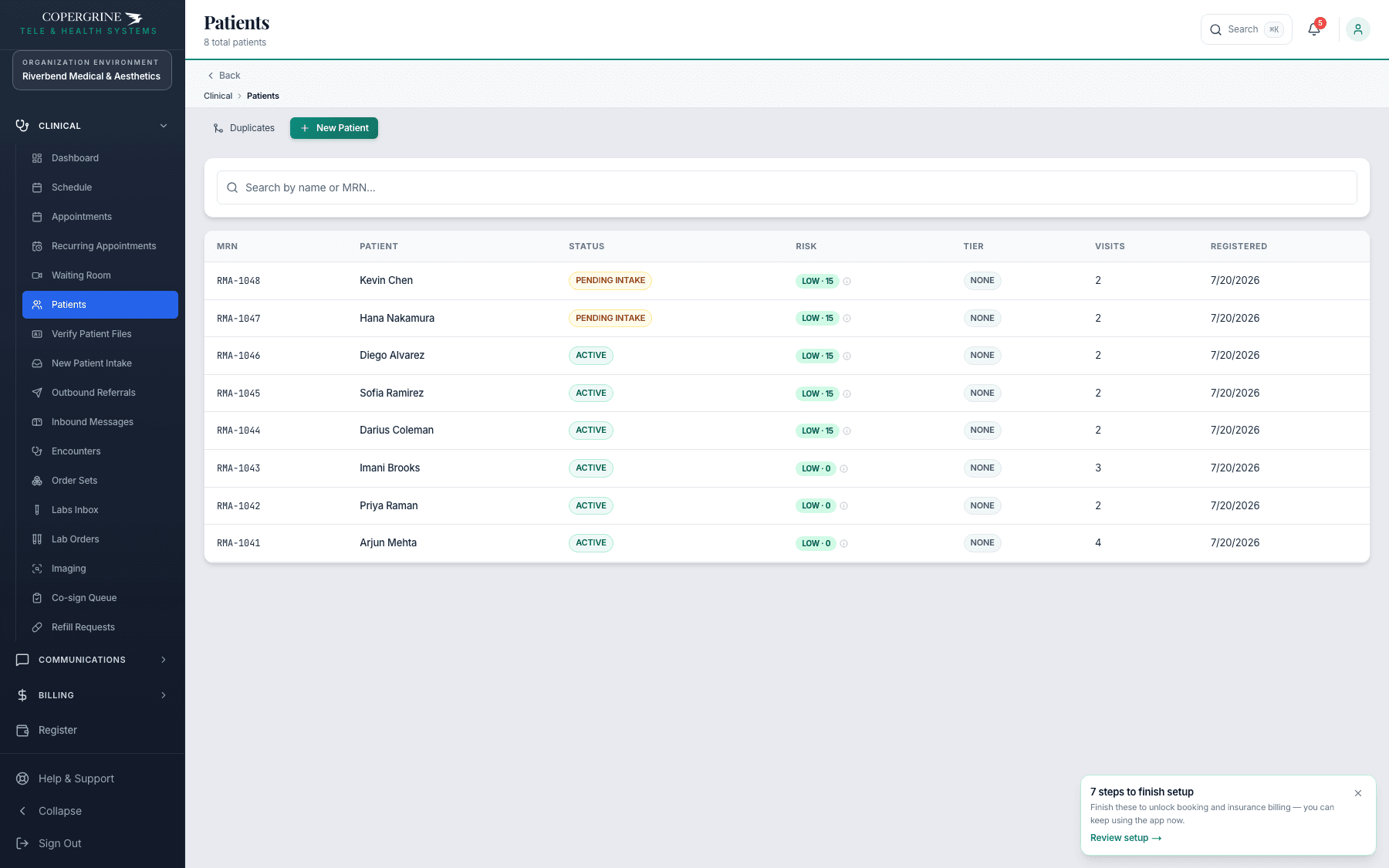
Your panel, searchable by MRN or name.

Active vs. inactive, payer tier (insurance, cash, Elite member), visit count, and registration history — without exporting to a spreadsheet.
  • Real MRN system, not just internal IDs
  • Tier badges for insurance, cash-pay, and membership patients
  • Search by name or MRN with sub-second results
  • One-click drill-down to encounters and documents
Patient roster with MRN, status, tier, visit count and registration date columns
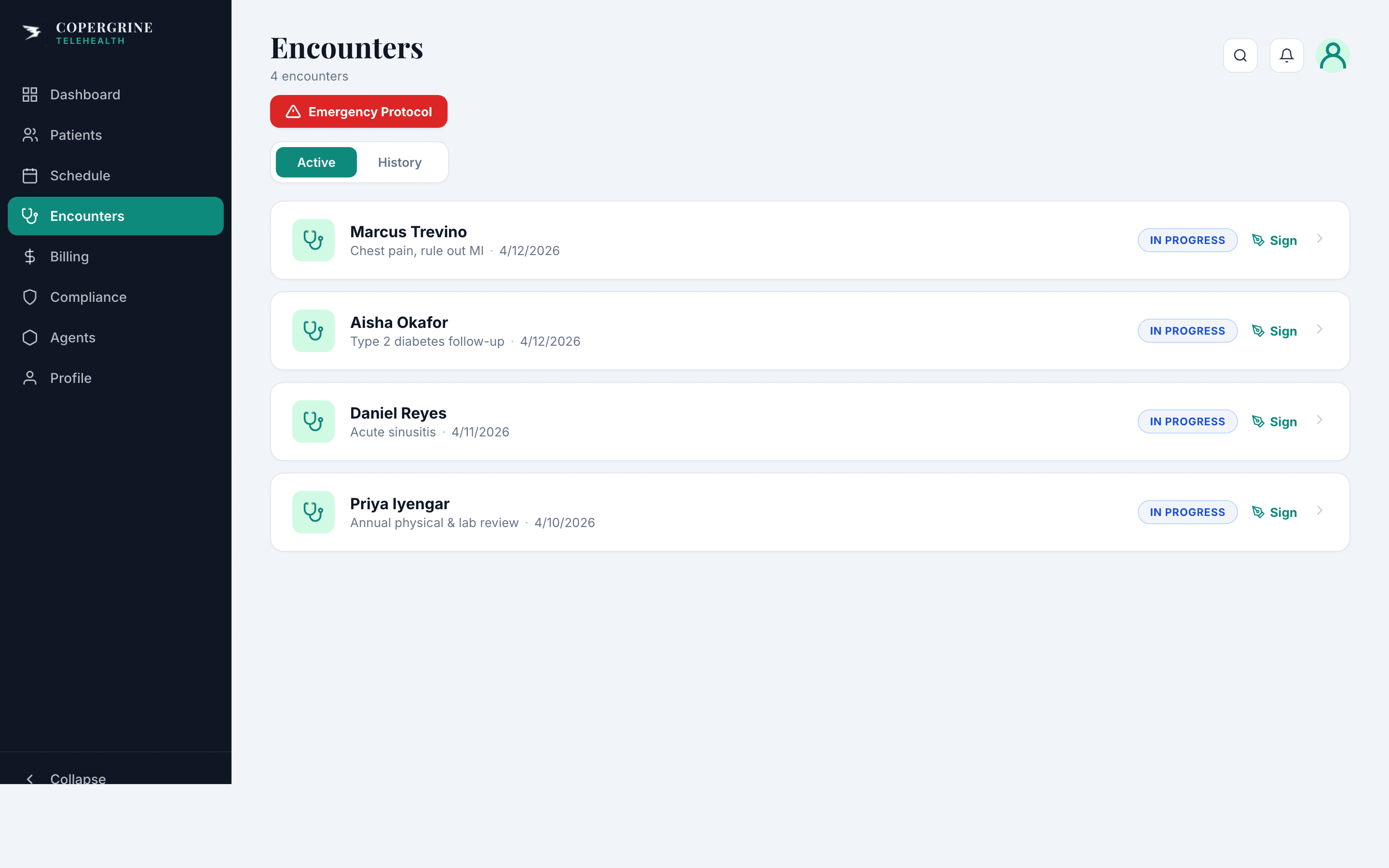
Active encounters list with four patients, IN PROGRESS badges, and Sign actions

04 · Encounters

Sign and lock without leaving the screen.

Active encounters waiting for documentation, ranked by urgency. Emergency protocol button surfaces critical patients first. Sign and lock ships the encounter to billing automatically.

  • Active vs. history filter
  • Emergency protocol surfaces red-flag patients
  • In-progress vs. signed status per encounter
  • One-click sign-and-lock pushes to billing + claims

Inside the visit

The live visit, eligibility, and your brand.

The telehealth call with the ambient AI scribe drafting the note, real-time insurance eligibility with the patient's cost, and a platform that is fully your brand.

Telehealth video visit with the ambient AI scribe transcribing the provider and patient conversation in real time and suggesting chart items

Live visit + ambient AI scribe

Video, the conversation transcribed in real time, scribe-suggested chart items — the provider reviews and signs.
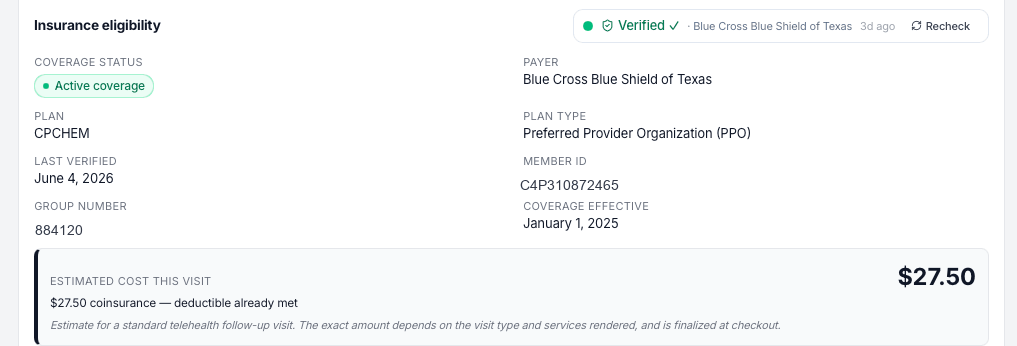
Real-time insurance eligibility check — verified active coverage with Blue Cross Blue Shield of Texas, member ID, group, and the patient's estimated cost

Insurance & eligibility check

270/271 verification, active coverage, and the patient's estimated cost — confirmed before the visit.
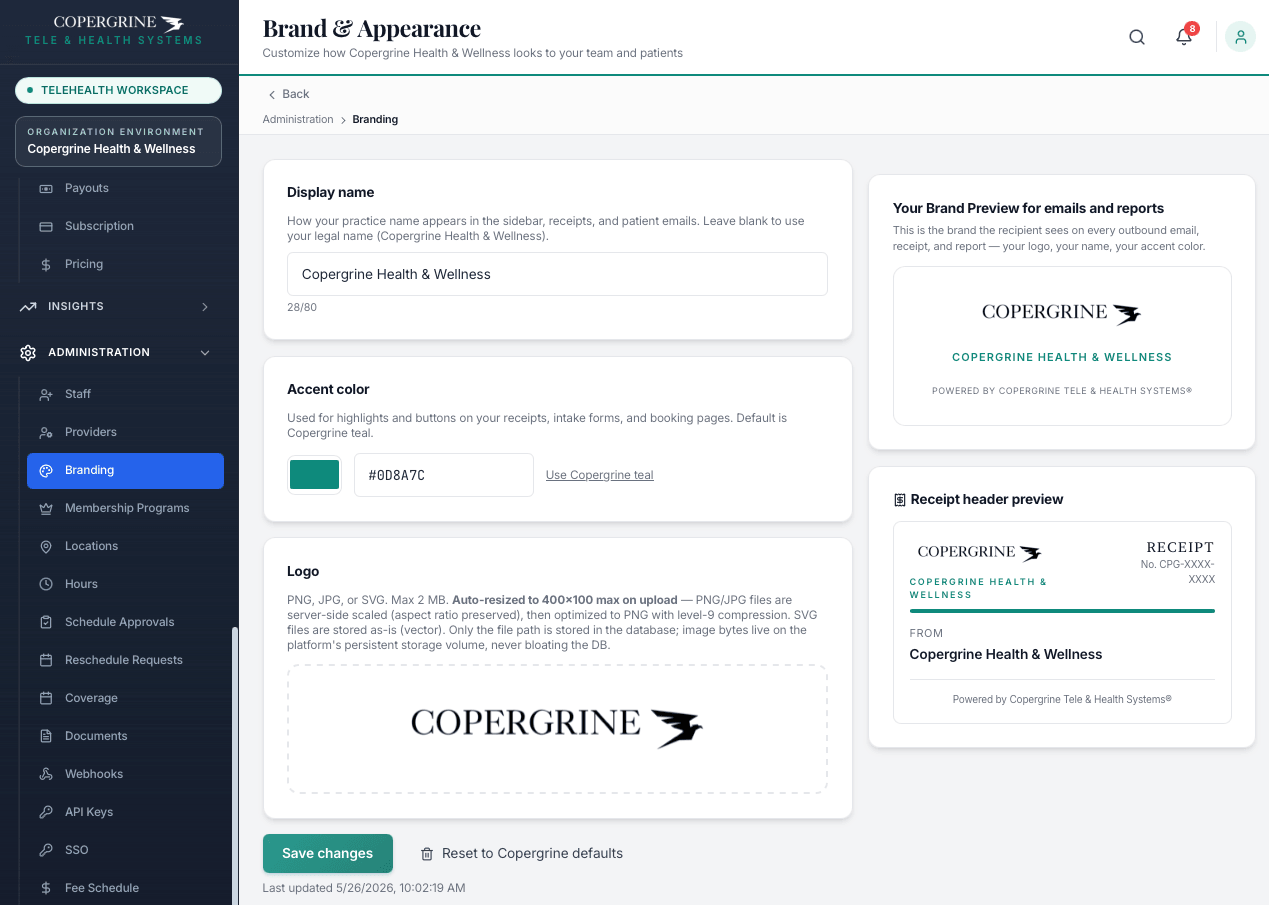
White-label branding — your practice display name, accent color, and logo applied to patient emails, receipts, statements, and portal

Your brand, not ours

Logo, name, and color on every patient-facing surface — “Powered by Copergrine” stays in the footer.

05 · The headline feature

Document at the speed of speech.

The ambient scribe listens to your conversation with the patient and drafts the full encounter note in real time. ICD-10 and CPT codes auto-suggested from a 74,000+ code library. Confirmed diagnoses surface evidence-based treatment plans drawn from major society guidelines. You sign and lock.
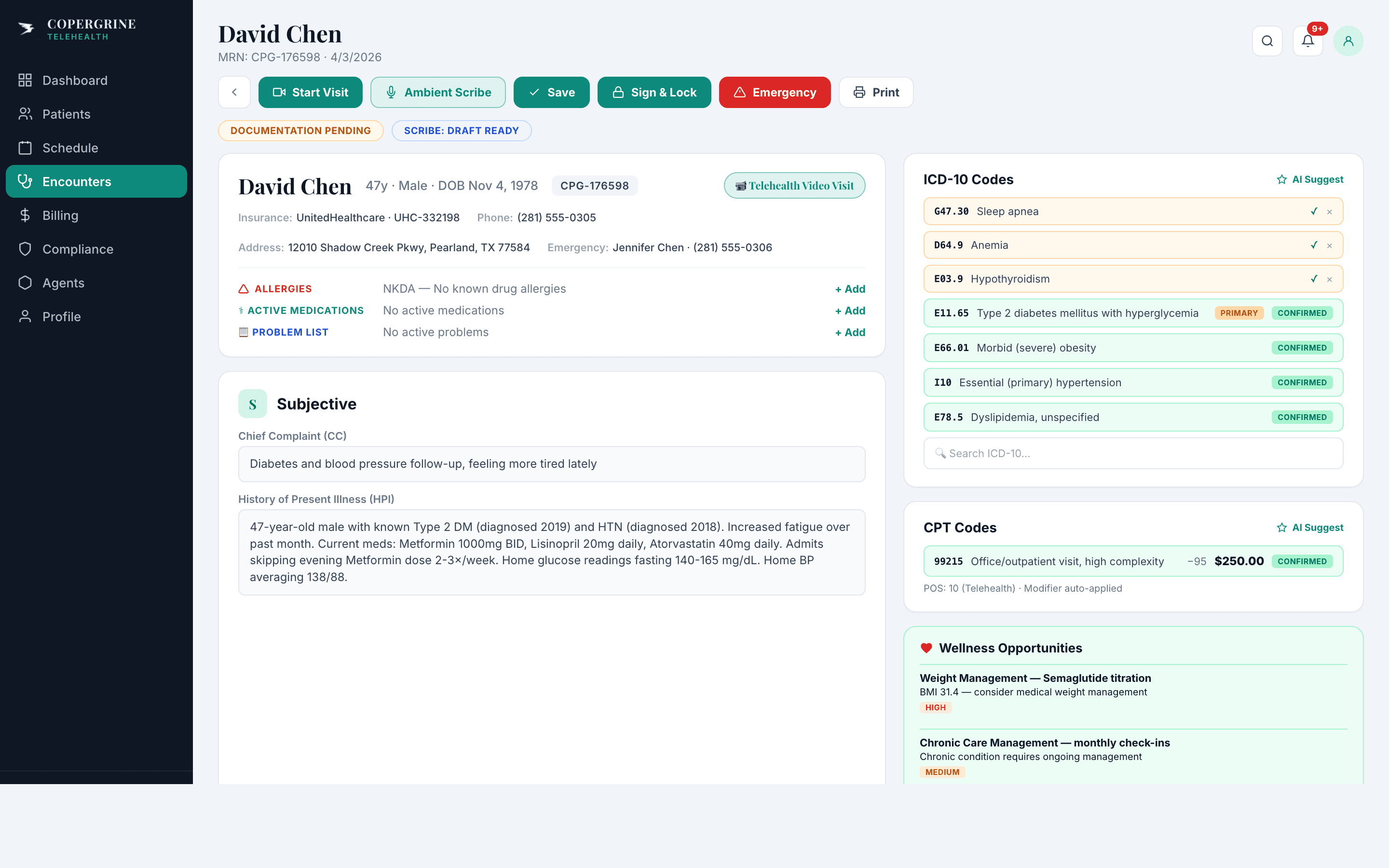
  • Ambient scribe drafts CC, HPI, ROS, A/P while you talk
  • 74,000+ ICD-10 code library with AI-ranked suggestions
  • CPT auto-coding from visit type, complexity, and duration
  • Built-in evidence-based treatment plans (ADA, AHA/ACC, AACE)
  • Wellness opportunities surfaced from the patient's problem list
  • One-click sign-and-lock pushes the encounter to billing
74k+
ICD-10 codes
Sign-off
on every AI draft
EPCS
compliant
David Chen encounter detail with ambient scribe draft, AI-suggested ICD-10 codes, a CPT 99215 charge line, and wellness opportunities

06 · Patient communication

Reach patients without paying for SMS.

Free, HIPAA-compliant push notifications on iOS, Android, and desktop. No SMS bills, no third-party messaging vendors, no patient data sold to advertisers. The platform runs on infrastructure we control end to end.
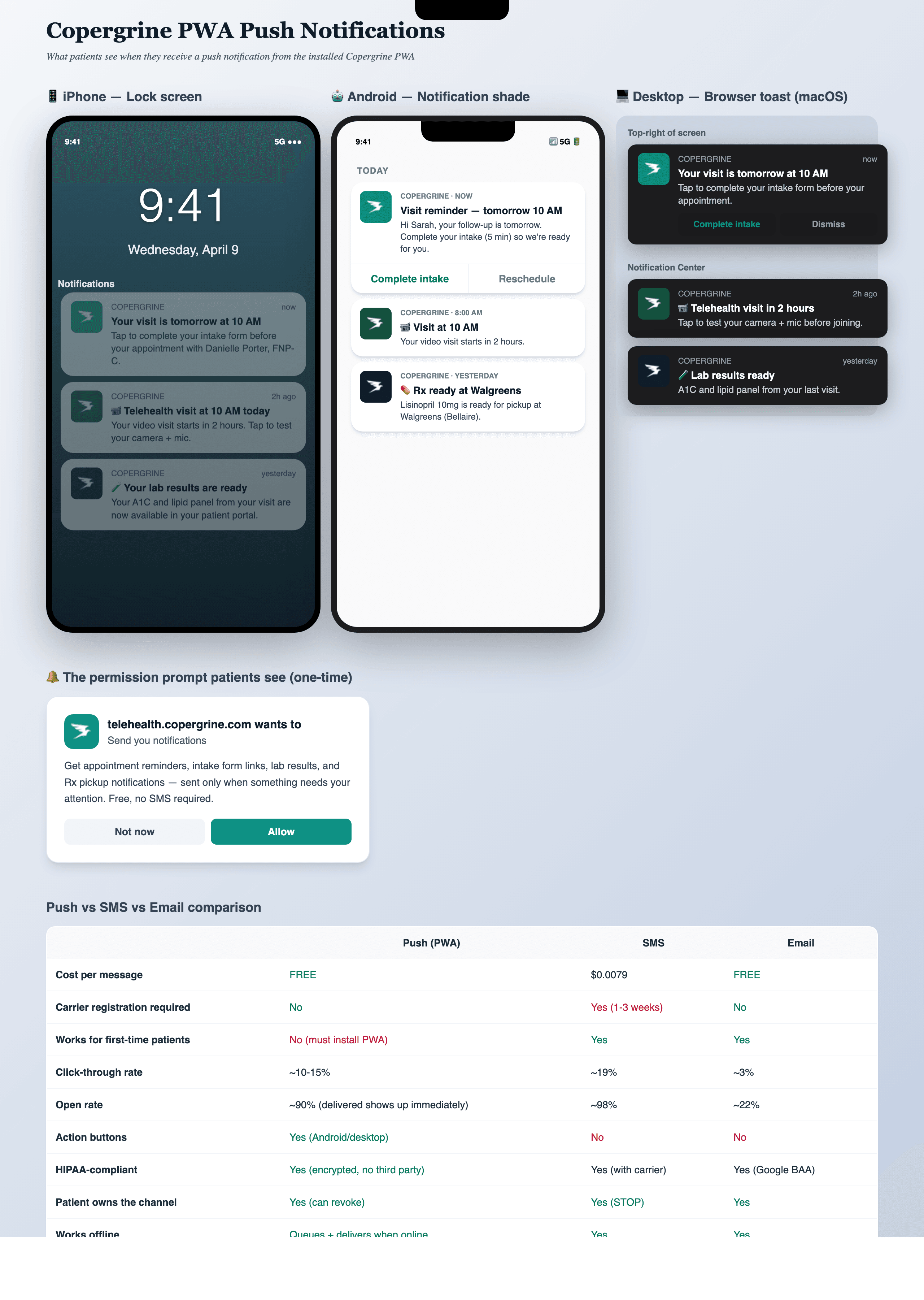
  • Free per-message — carriers bill SMS by the message
  • Action buttons (Complete intake, Reschedule, Join visit)
  • No carrier registration, no 10DLC paperwork
Copergrine PWA push notifications across iPhone lock screen, Android shade, and desktop browser toast
HIPAA-compliant
Encryption in transit + at rest
BAA with every practice
Standard, no extra fee
TLS 1.3 + audit logs
Every access logged
No 3rd-party advertising
Patient data never sold

Pricing

One platform. Two published ways to license it.

Published seat pricing for solo and group practices on the Medical Practice EMR line. $229 per provider seat per month for your first 6 months, then $380 per month thereafter. Everything is included at both rates: no feature upgrades, no per-visit fees, no clearinghouse surcharges. The introductory rate is a 6-month, monthly-only promo. Annual prepay at the standard rate: $4,180 per provider seat per year — one month free versus $380/month, setup fee waived. A one-time $499 setup fee covers onboarding, data-migration assistance, and payer-enrollment support. It is waived in full on annual prepay. Medical groups can license concurrent clinical licenses instead — For first-time clients, $1,500 per month includes 5 concurrent clinical licenses and each additional concurrent license is $285 per month for the first 6 months; then $2,000 per month includes 5 concurrent clinical licenses, and each additional concurrent license is $380 per month, with unlimited locations. Every clinician keeps an individual account. Group is billed monthly. No long-term commitment on monthly plans: there is no minimum term, and cancellation takes effect at the end of the current billing period. The Master Subscription Agreement and Business Associate Agreement still govern. Health systems get a custom-scoped implementation and agreement.

Medical Practice EMR · introductory rate for your first 6 months

$229/ provider seat / month · first 6 months

Standard rate thereafter: $380 / provider seat / month. The introductory rate is a 6-month, monthly-only offer for first-time clients. Annual prepay at the standard rate: $4,180 per provider seat per year — one month free versus $380/month, setup fee waived. A one-time $499 setup fee covers onboarding, data-migration assistance, and payer-enrollment support. It is waived in full on annual prepay. Everything is included at both rates — no feature upgrades, no per-visit fees, no clearinghouse surcharges. Your accepted Medical Practice EMR rate schedule, including the 6-month introductory-to-standard step, is protected for 24 calendar months. Adding or removing licenses still changes your total. It is not a 24-month commitment, and your rates do not increase automatically when the protection period ends.

Individual or Group: two ways to license Medical Practice EMR

Individual

Each clinician who documents holds their own provider seat. $229 per provider seat per month for your first 6 months, then $380 per month thereafter.

One seat per clinician who documents. Each provider account that starts, leads, signs or closes encounters needs its own seat; admin, billing, nursing and front-desk staff are free under your headcount cap.

Group

For first-time clients, $1,500 per month includes 5 concurrent clinical licenses and each additional concurrent license is $285 per month for the first 6 months; then $2,000 per month includes 5 concurrent clinical licenses, and each additional concurrent license is $380 per month, with unlimited locations. Every clinician keeps an individual account. Group is billed monthly.

Every clinician keeps an individual account. The licenses limit how many clinicians use clinical features at the same time, never who has an account. 5 concurrent licenses can cover 10 clinicians only when they work 2 non-overlapping shifts and no more than 5 use licensed clinical features at once.

Your accepted Medical Practice EMR rate schedule, including the 6-month introductory-to-standard step, is protected for 24 calendar months. Adding or removing licenses still changes your total. It is not a 24-month commitment, and your rates do not increase automatically when the protection period ends. A one-time $499 setup fee covers onboarding, data-migration assistance, and payer-enrollment support. It is waived in full on annual prepay.

How the recurring price compares

Two vendors that publish a recurring provider price for a comparable plan category, each from its own pricing page, retrieved September 22, 2026.

Advertised planMedical Practice EMR Individual, regular rateDifference
Tebra Practice Essentials, physician, standard volume: $599 per provider per month

Tebra describes this as typical pricing; provider category, specialty, claim volume, bundle and configuration affect a quote, and Tebra publishes lower categories.

$380 a month$219 a month lower (about 37%)
eClinicalWorks EHR with Practice Management: $599 per provider per month

eClinicalWorks advertises no start-up costs for this plan and a separate, lower-priced EHR Only plan; training, implementation above nine providers, airfare and transaction fees are described separately.

$380 a month$219 a month lower (about 37%)

Advertised recurring provider prices only; configurations, provider categories, implementation, transactions, add-ons, taxes, contract terms and included capabilities differ. The comparison uses the regular rate; Medical Practice EMR starts at the introductory rate — $229 per provider seat per month for your first 6 months, then $380 per month thereafter. A one-time $499 setup fee covers onboarding, data-migration assistance, and payer-enrollment support. It is waived in full on annual prepay. It is not a feature, quote, contract-term or total-cost comparison.

What does a demo look like?

30 minutes, focused on the part of your workflow you care about most. Pick one of:

  • Charting + encounters: see how clinical notes flow from intake to billing
  • Telehealth: experience a virtual visit from both patient and provider sides
  • E-prescribing: see prescriptions go from encounter to pharmacy in under a minute
  • Billing + claims: walk through eligibility, claim submission, and ERA processing
  • Patient portal + push notifications: understand how reminders reach patients
  • AI scribe + coding: live demo with a sample encounter

After the demo we give you a written assessment of fit and a rough onboarding timeline — no obligation. Solo and group-practice pricing is published above: $229 per provider seat per month for your first 6 months, then $380 per month thereafter. Health systems: we follow up within 48 hours with a scoped implementation quote and an MSA draft.

Frequently asked questions

Who is the Copergrine platform built for?
Three audiences, one platform. Solo providers (DPC, solo primary care, in-person, virtual or hybrid) running their whole practice on a single bill. Medical groups, single- or multi-site, consolidating charting, telehealth, scribe, e-prescribing and claims — on Individual licenses, or on concurrent Group licenses when clinicians work non-overlapping shifts. Health systems and multi-entity organizations, whose implementations are custom-scoped. Individual and Group pricing are published.
What's included at the $229 introductory rate?
Everything. EMR + charting, scheduling, patient portal, telehealth video, AI ambient scribe, e-prescribing with EPCS, eligibility checks, claims submission, push notifications, and HIPAA BAA. No per-feature upgrades, no per-visit fees, no claims clearinghouse surcharges. $229 per provider seat per month for your first 6 months, then $380 per month thereafter.
Why does the rate step up after 6 months?
The first 6 months are an introductory rate: full-feature, no claw-back, billed monthly, with no annual option. $229 per provider seat per month for your first 6 months, then $380 per month thereafter. That step is part of the schedule you accept, not a surprise: Your accepted Medical Practice EMR rate schedule, including the 6-month introductory-to-standard step, is protected for 24 calendar months. Adding or removing licenses still changes your total. It is not a 24-month commitment, and your rates do not increase automatically when the protection period ends. You'll see a reminder before the introductory period ends. Annual prepay at the standard rate: $4,180 per provider seat per year — one month free versus $380/month, setup fee waived.
Is there a setup fee?
A one-time $499 setup fee covers onboarding, data-migration assistance, and payer-enrollment support. It is waived in full on annual prepay. The introductory rate is a 6-month, monthly-only promo with no annual option. Annual prepay at the standard rate: $4,180 per provider seat per year — one month free versus $380/month, setup fee waived. Health-system implementations are scoped separately: a custom statement of work replaces the $499 onboarding fee and includes dedicated implementation engineers, integration work (HL7/FHIR, SSO/SAML), and per-site go-live support.
What does the AI ambient scribe actually do?
While you have a normal conversation with a patient, the scribe listens, transcribes, and drafts the encounter note in real time — chief complaint, HPI, ROS, assessment, and plan. You review and edit, then sign and lock — nothing reaches the chart without your sign-off.
How accurate are the ICD-10 and CPT code suggestions?
The platform searches a 74,000+ ICD-10 code library against the encounter content and the patient's problem list, then proposes the most likely codes. CPT suggestions are based on visit type, complexity, and duration. You confirm or override every code before billing — nothing is auto-submitted.
What is built-in evidence-based practice?
When you confirm a diagnosis, the platform automatically surfaces the relevant evidence-based treatment plan from major society guidelines (ADA, AHA/ACC, AACE, USPSTF, IDSA, AAFP, ACOG, AAP) — first-line medications, monitoring schedule, red flags, and lifestyle interventions. It is a clinical decision support layer, not a replacement for your judgment. See the full explainer and a sample Type 2 DM plan at /emr/evidence-based-care.
Does Copergrine scale past a small practice?
Yes. Individual pricing on the Medical Practice EMR line is the same rate whether you have 1 provider or 100 — no seat tiering that penalizes growth. $229 per provider seat per month for your first 6 months, then $380 per month thereafter. Medical groups whose clinicians work non-overlapping shifts can license concurrent clinical licenses instead: For first-time clients, $1,500 per month includes 5 concurrent clinical licenses and each additional concurrent license is $285 per month for the first 6 months; then $2,000 per month includes 5 concurrent clinical licenses, and each additional concurrent license is $380 per month, with unlimited locations. Every clinician keeps an individual account. Group is billed monthly. Every clinician keeps an individual account. The licenses limit how many clinicians use clinical features at the same time, never who has an account. 5 concurrent licenses can cover 10 clinicians only when they work 2 non-overlapping shifts and no more than 5 use licensed clinical features at once. Health systems and multi-entity organizations work under a custom-scoped agreement.
Do I keep my own patient revenue?
Yes, 100%. Copergrine uses a BYO-Stripe architecture — you connect your own Stripe account, your patients pay you directly, and we never touch your revenue.
How long does data migration take?
Typically 3 to 7 business days for a standard EMR migration. We handle the mapping, you verify a test sample, then we cut over. Migrations from Tebra, DrChrono, Elation, and Practice Fusion are well-trodden paths. Migrations from Athenahealth or eClinicalWorks take longer due to export restrictions on their end.
What is the onboarding timeline?
Solo providers: 1 to 2 weeks — you're often live within 10 business days of contract. Small and mid-size group practices: 2 to 4 weeks, including data migration from your current EMR, staff training, and a parallel-running go-live. Health systems: typically 8 to 12 weeks for a first-site pilot, then 2 to 3 weeks per additional site once the reference architecture is in place. Every implementation includes parallel running until your team signs off.
How is patient data protected and who owns it?
All patient data is encrypted in transit and at rest, access is audit-logged, and we sign a BAA with every practice. The platform runs on dedicated infrastructure we control end to end — no third-party advertising vendors, no data shared with advertisers. You own your data. Full export is available any time in CCDA, CSV, and PDF. If you ever leave, you walk away with everything — no extraction fees, no proprietary lock-in.
How does the price compare with other EMRs?
Only on advertised recurring price, and only against named plans. Tebra Practice Essentials, physician, standard volume: $599 per provider per month, per its official pricing page, retrieved September 22, 2026. Tebra describes this as typical pricing; provider category, specialty, claim volume, bundle and configuration affect a quote, and Tebra publishes lower categories. eClinicalWorks EHR with Practice Management: $599 per provider per month, per its official pricing page, retrieved September 22, 2026. eClinicalWorks advertises no start-up costs for this plan and a separate, lower-priced EHR Only plan; training, implementation above nine providers, airfare and transaction fees are described separately. Against either advertised price, the regular Medical Practice EMR Individual rate of $380 a month is $219 a month lower, about 37% lower. Advertised recurring provider prices only; configurations, provider categories, implementation, transactions, add-ons, taxes, contract terms and included capabilities differ. Copergrine starts at the introductory rate — $229 per provider seat per month for your first 6 months, then $380 per month thereafter. A one-time $499 setup fee covers onboarding, data-migration assistance, and payer-enrollment support. It is waived in full on annual prepay.
Individual or Group — which should we choose?
Individual gives each clinician who documents their own provider seat. Group suits medical practices that share concurrent clinical licenses across locations: For first-time clients, $1,500 per month includes 5 concurrent clinical licenses and each additional concurrent license is $285 per month for the first 6 months; then $2,000 per month includes 5 concurrent clinical licenses, and each additional concurrent license is $380 per month, with unlimited locations. Every clinician keeps an individual account. Group is billed monthly. Every clinician keeps an individual account. The licenses limit how many clinicians use clinical features at the same time, never who has an account. 5 concurrent licenses can cover 10 clinicians only when they work 2 non-overlapping shifts and no more than 5 use licensed clinical features at once. Moving from Individual to Group is an explicit confirmation that takes effect at a supported billing boundary; it starts a new 24-calendar-month protection period from that date, with no new trial, setup fee or proration. Adding Group licenses later keeps the accepted additional-license rate and the original protection end date.
Is there a long-term commitment?
No long-term commitment on monthly plans: there is no minimum term, and cancellation takes effect at the end of the current billing period. The Master Subscription Agreement and Business Associate Agreement still govern. Your accepted Medical Practice EMR rate schedule, including the 6-month introductory-to-standard step, is protected for 24 calendar months. Adding or removing licenses still changes your total. It is not a 24-month commitment, and your rates do not increase automatically when the protection period ends. On annual prepay, a subscriber who cancels is entitled to a prorated refund of unused full months, requested at app.copergrine.com/support/new by choosing Billing. Scheduling cancellation does not by itself process a refund.
What about compliance reports for health-system procurement?
We provide a HIPAA compliance attestation and BAA with every contract. For health-system and IDN procurement, we support vendor risk assessments (HECVAT Lite and Full), provide a security architecture document, and can execute under a customer-supplied MSA. SOC 2 Type II is on the 2026 roadmap; until then we operate under documented SOC 2-aligned controls (access review, change management, incident response, vendor risk, backup testing) with audit-log export available to your GRC team on request.
Do you support SSO, HL7/FHIR, and other enterprise integrations?
Yes — these are table stakes for group practices and required for health systems. SSO via SAML 2.0 and OIDC (Okta, Entra ID, Google Workspace). HL7 v2 lab order workflow with vendor connectors for Quest and Labcorp (per-tenant account onboarding); inbound HL7 ORU result delivery to the encounter chart. FHIR R4 for interoperability and patient data exchange. Webhook-based event streams for BI warehouses. Integrations are included on group-practice and health-system agreements; for solo tier, ask if you need one and we'll scope it.
How do I get a demo?
Use the email link on this page or the Book a 30-min demo button. We will set up a 30-minute walk-through of the part of your workflow you care about most: charting, billing, e-prescribing, patient messaging, or scheduling.

Ready to start seeing patients?

Spin up your EMR in minutes — with a 14-day free trial. A card is required to start; nothing is charged until the trial ends.