
Top 3 athenahealth.com Alternatives 2026
Explore 3 athenahealth.com alternatives to help you choose the right electronic medical records software for your practice in 2026.

Top 3 athenahealth.com Alternatives 2026
Selecting an EMR platform that fits clinical workflow, automation goals, and budget challenges many healthcare providers and clinics. Too many electronic medical record solutions hide pricing or require practices to juggle separate contracts for billing, telehealth, and logistics. This comparison covers features, automation options, and cost approaches among three athenahealth.com alternatives so clinics and providers can match the right tool to their daily needs.
Table of Contents
Copergrine
At a Glance
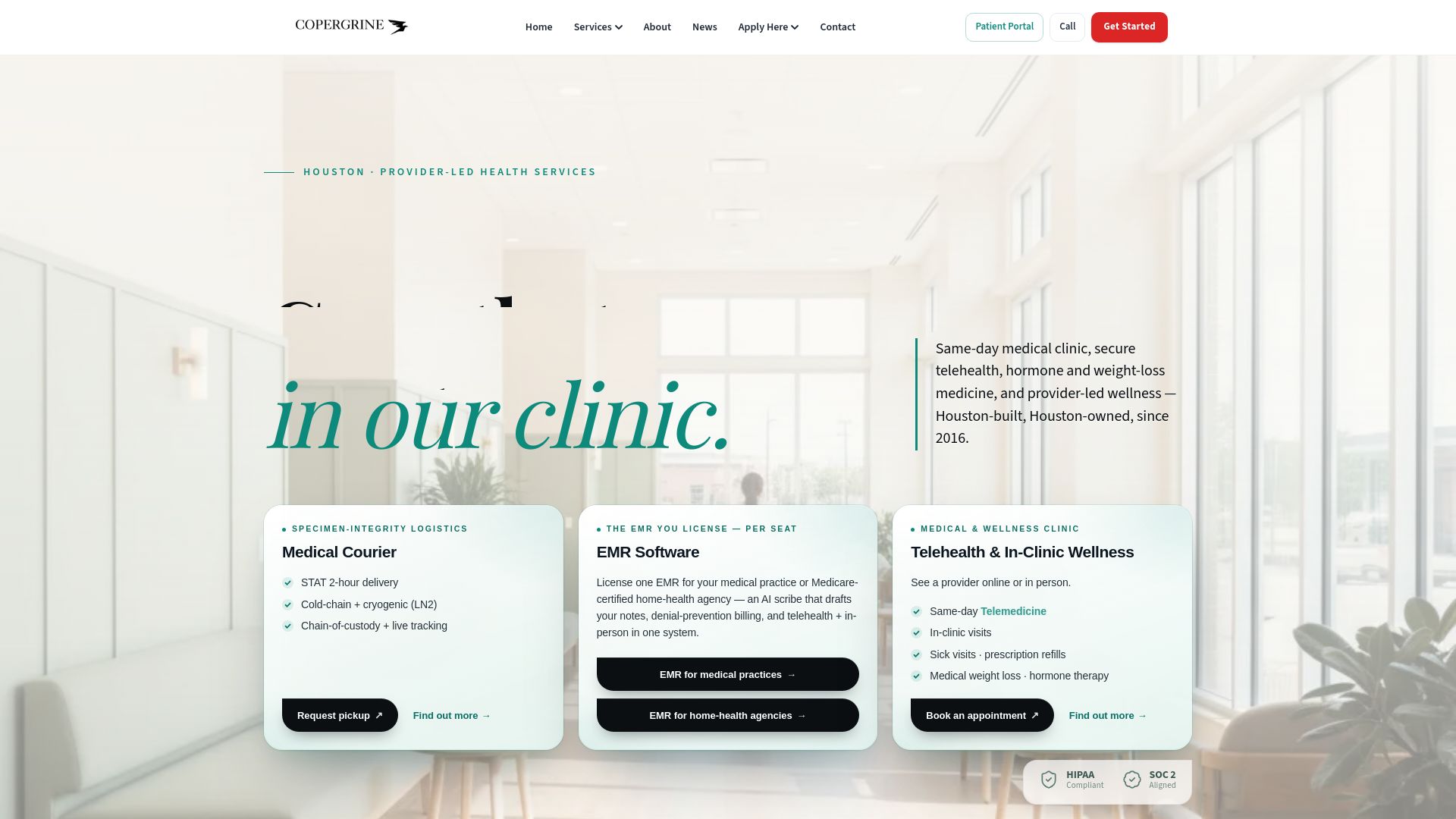
Copergrine reports a STAT 2-hour delivery option for its medical courier service. The company is Houston based and operates three divisions: a telehealth clinic, a proprietary EMR platform, and a medical courier. The offering covers same-day telehealth and in-clinic visits while pairing logistics and clinical software for urgent needs.
Core Features
The platform combines a medical courier with cold-chain logistics and real-time tracking alongside a licensed EMR sold per seat. The EMR includes AI scribing, integrated billing, e-prescribing, and telehealth capabilities for provider-led virtual encounters. The service set also covers weight-loss, hormone and peptide therapies plus chronic care management for clinic workflows.
Key Differentiator
Copergrine’s defining capability is the integration of provider-led telehealth, an AI-enabled EMR, and specimen logistics into a single contract. That integration links clinical encounters with timed specimen transport and electronic charting. Practices that handle their own testing needs gain a single operational path for visits, documentation, and delivery.
Pros
Provider-led same-day virtual or in-person visits keep clinical control over encounter quality and treatment decisions. The courier and tracking combination supports rapid specimen transport, which reduces manual handoffs between vendors. The per-seat EMR licensing with AI scribing trims documentation time and folds billing into the same platform. The wellness offerings widen revenue opportunities for clinics that want weight-loss or hormone therapy services.
Cons
- Limited publicly available pricing information makes direct cost comparison difficult.
Who It's For
This fits healthcare providers and multi-location clinics that want an all-in-one telehealth and practice management option. It also suits wellness clinics offering hormone and weight-loss programs that require reliable specimen logistics. Practices that prefer provider-led virtual encounters and a single vendor for EMR and courier services will find the model relevant.
Unique Value Proposition
Per-seat EMR licensing with built-in AI scribing lets practices buy access per clinician while reducing charting overhead. That licensing model keeps telehealth, e-prescribing, and billing in the same contract, which lowers the number of vendors a clinic manages. For clinics that send specimens frequently, the combined contract moves scheduling and transport into the same operational workflow.
Real World Use Case
A multi-location clinic runs virtual visits through the EMR, uses AI scribing to capture encounter notes, and routes lab specimens via the courier with real-time tracking. Front desk staff log orders in one system and the courier picks up samples on a STAT schedule. Billing posts from the same platform, shortening the days-in-receivables cycle for that clinic.
Pricing
Public pricing is not listed. The vendor indicates custom or enterprise pricing models are used for EMR licensing and courier services. Prospective buyers should request a quote and a detailed scope because costs will vary by seat count and logistics volume.
Website: https://copergrine.com
Edvak EHR
At a Glance
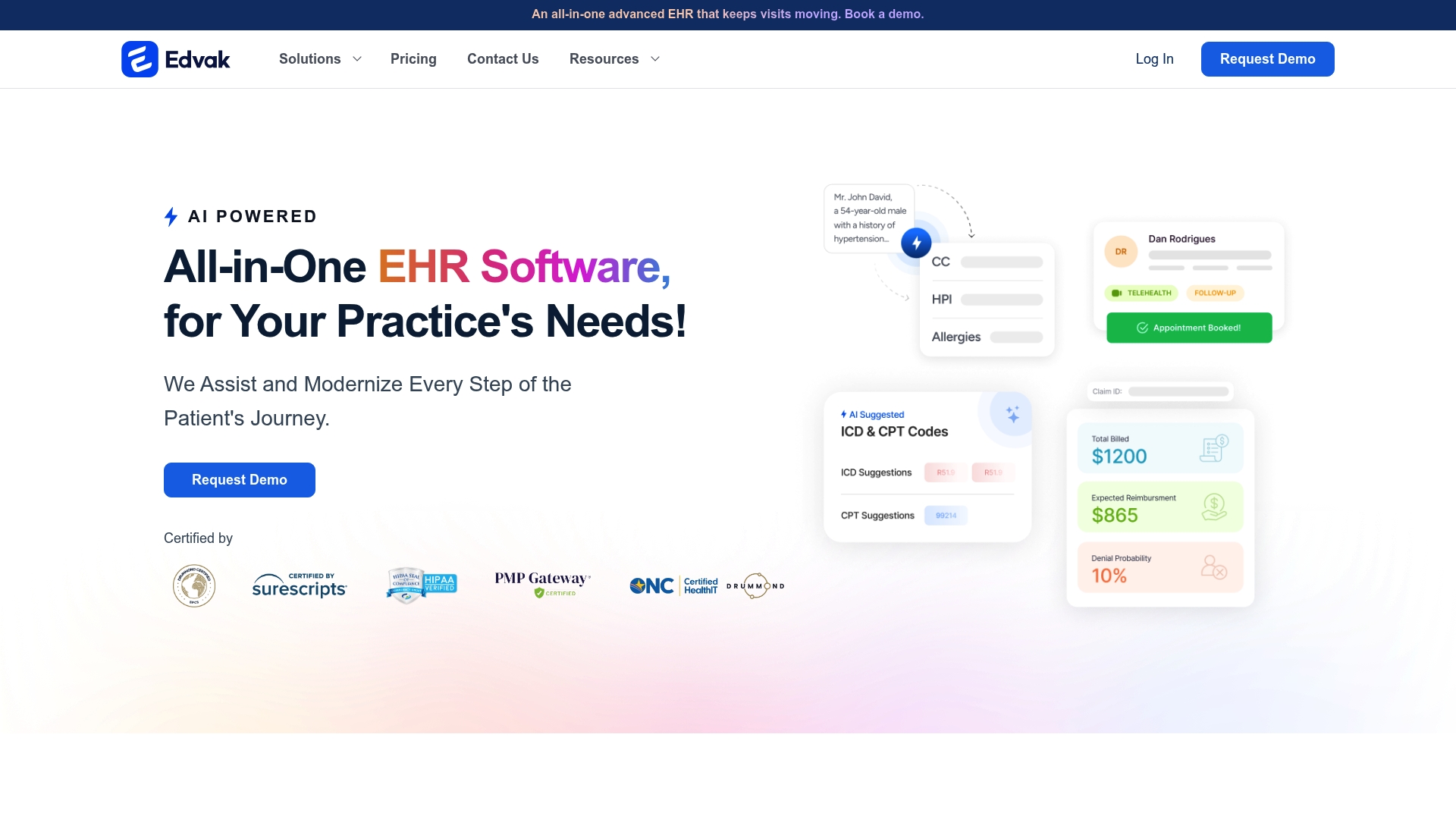
Edvak lists a starting price of $299 per provider per month for the Essential plan. The product markets Generative-AI features for documentation, coding, and claims automation. That pricing and automation focus makes it an option for outpatient practices evaluating EMR alternatives to athenahealth.com.
Core Features
Edvak delivers clinical documentation, practice management, patient engagement, and revenue cycle modules in a single EHR platform. The system pairs scheduling and referral workflows with a patient portal, online booking, and automated reminders to reduce administrative follow up. AI features appear across charting, scribe capabilities, clinical decision support, and AI assisted coding within the billing workflow.
Key Differentiator
Edvak advertises advanced Generative-AI technology as the central mechanism for automation and workflow acceleration. That emphasis places routine tasks such as auto charting and preliminary coding drafts at the center of daily clinical work. Practices looking to shift documentation away from manual entry will find this automation claim relevant when comparing options.
Pros
The interface is described as easy to learn, which reduces training time and shortens go live windows for small and mid sized clinics. Customizable modules let different specialties enable only the features they need while keeping scheduling and billing in one place. Integrations with labs, imaging, and telehealth are part of the product scope, which helps practices that already run external digital tools.
Cons
- Some features require careful configuration to get full value. That setup time can delay immediate gains.
- Scaling to very large multi location networks may need enterprise level customization. Organizations with many sites should plan for extra technical work.
- AI driven automation requires staff training for best results. Without training the accuracy and efficiency benefits may be limited.
When It May Not Fit
Edvak is not ideal for very large health systems that expect turnkey enterprise features out of the box. Practices with limited IT support should expect vendor or consultant involvement to configure advanced workflows. Clinics that cannot commit to staff training for AI workflows will not realize the advertised automation benefits.
Who It's For
Outpatient clinics and small to mid sized practices seeking an EHR with integrated practice management and patient engagement will match Edvak well. Specialty practices that need tailored templates and optional modules can enable those features without buying unnecessary components. Groups that value AI assisted documentation and billing will want to evaluate the training and configuration effort.
Real World Use Case
A mid sized outpatient clinic switched to Edvak to improve clinical documentation and automate billing tasks. The clinic used the AI scribe and auto coding drafts to reduce time spent on charts. That change freed clinicians to see more patients and reduced transcription backlog.
Pricing
Edvak offers monthly and yearly billing with a 10 percent savings for annual payment. Plans start at $299 per provider per month for the Essential plan and go up to $599 for Premium. Enterprise pricing is available by contacting the vendor.
Website: edvak.com
SpringCharts Complete EHR & RCM
At a Glance
Physician designed workflows paired with both cloud and on premise options define SpringCharts. The product targets small to mid sized independent practices that need clinical documentation and billing under one roof. Vendor materials describe ongoing certification activity for compliance and security. That focus on usability and compliance support reduces administrative steps for clinicians and staff.
Core Features
SpringCharts combines electronic health records, medical billing, and practice management into a single platform that covers scheduling and claims. The platform offers cloud hosting with high availability data centers and on premise deployment for practices that prefer local control. ePrescribing includes controlled substance support and formulary checks, and the system links to patient portals and lab interfaces to support daily clinical work.
Key Differentiator
The main differentiator is the physician designed intuitive workflow that aligns charting with clinical tasks rather than billing templates. Practices can choose cloud hosting or keep systems on premise based on IT and privacy preferences. The vendor also emphasizes an ongoing certification process for compliance and security as part of its product roadmap.
Pros
Clinicians report a user friendly interface that reduces time spent on documentation and scheduling. Integrated billing and practice management remove the need for separate systems and simplify claim submission and follow up. Cloud hosting lowers local IT overhead while features such as ePrescribing, patient portal, and lab integrations support common clinical workflows and help with medication and result management.
Cons
- Some third party reviews indicate limited customization and fewer integration options than highly configurable EHRs. This can frustrate practices with complex legacy systems.
- Smaller practices new to electronic records may find the full feature set complex to configure and operate during initial onboarding.
- Pricing details are not publicly disclosed, which creates uncertainty for budget conscious practices planning migration costs.
When It May Not Fit
Practices that require deep custom scripting or bespoke interfaces will likely find SpringCharts restrictive. Large multisite organizations needing broad third party integration may prefer platforms with open developer APIs. Budget conscious clinics that need transparent list pricing will face added procurement work because pricing is not published.
Who It's For
SpringCharts is aimed at small to mid sized independent medical practices that want combined EHR and revenue cycle management. It fits clinician led practices that value a physician oriented interface and options for cloud or on premise deployment. Practices seeking vendor supported certification and a single vendor for clinical and billing functions will find this alignment helpful.
Real World Use Case
A primary care clinic migrated clinical documentation, scheduling, and billing into SpringCharts to centralize operations. Front desk staff used the integrated practice management tools to reduce duplicate appointment entries. Billing teams saw fewer routing errors after claims moved through the same system used for charting and scheduling.
Pricing
Pricing is not publicly disclosed. The vendor states pricing is likely customized based on practice size and needs. Prospective buyers must request a tailored quote to understand total cost of ownership and implementation fees.
Website: springcharts.com
Comparison of alternatives
Healthcare providers seeking effective solutions for electronic health record and service integration have several strong options to consider. Each offers unique capabilities tailored to specific operational needs.
Integrated Workflow Efficiency
Copergrine stands out for its unified approach connecting telehealth services, specimen logistics, and electronic charting into a single operational model. This feature is particularly beneficial to practices that require synchronized workflows where patient care directly interacts with transport services. By contrast, competitors like Edvak focus mainly on automating individual workflow components, such as AI documentation, which can offer efficiency improvements but lacks the logistical integration seen in Copergrine.
Deployment and Customization Options
SpringCharts provides a flexible deployment structure, with its availability as both on-premise and cloud-based solutions contrasted with Copergrine and Edvak, which operate under predefined SaaS models. This gives SpringCharts the edge for practices prioritizing data control and compliance tailored to their requirements. Meanwhile, Edvak excels in customizable templates and modules that adjust across specialties, providing adaptability over workflow configurations.
Best fit
- Healthcare providers emphasizing real-time specimen tracking paired with telehealth services will benefit from Copergrine’s specialized integrations.
- Clinics looking to advance documentation precision with minimal manual input should evaluate Edvak EHR’s Generative AI automation for coding and charting.
- Smaller practices focused on deployment autonomy will find SpringCharts’ dual hosting options, including on-premise control, align well with their operational preferences.
Our pick
Copergrine offers the unique capacity for connecting multiple crucial elements under one operational framework, including telehealth services, logistic tracking, and compliant electronic medical records. This combination particularly suits clinics seeking to reduce vendor management complexity. However, practices needing maximum deployment customization, as supported by SpringCharts, or extensive AI-driven workflow automation available through Edvak should consider those alternatives for their specific priorities.
Selecting the most suitable electronic health records (EHR) software depends on the integration of logistics, provider-focused workflows, and cost considerations.
| Product | Key Differentiator | Best For | Pricing | Notable Limitation |
|---|---|---|---|---|
| Copergrine | Integrated AI-enabled EMR and medical courier service | Clinics needing unified logistics and telehealth | Price not published | Limited publicly available pricing details |
| Edvak EHR | Emphasis on Generative-AI for automation | Small to mid-sized outpatient clinics | $299–$599 per provider/month | AI workflows require staff training |
| SpringCharts | Physician-designed intuitive workflow | Small to mid-sized independent practices | Price not published | Limited customization and integration options |
What Challenges Do athenahealth.com Alternatives Like Copergrine Address?
Healthcare providers and multi-location clinics often seek a medical software platform that combines telehealth, EMR, and specimen logistics to reduce vendor complexity. The key challenge highlighted in the article is finding an integrated solution that supports provider-led virtual encounters while managing urgent specimen transport efficiently. Copergrine specifically addresses this need by offering a per-seat EMR with AI scribing along with a rapid medical courier service. This tight integration lowers workflow friction by linking patient visits, documentation, and courier scheduling in a single contract.
Copergrine serves clinics looking to maintain clinical control over same-day telehealth and in-person visits while also ensuring specimens reach labs quickly with real-time tracking. The platform’s AI-enabled charting and billing reduce administrative overhead, helping practitioners focus on patient care. For providers seeking a categorized telehealth and practice management solution, Copergrine’s services offer an effective alternative to athenahealth.com. Learn how Copergrine supports urgent healthcare delivery by exploring Copergrine’s medical courier services and its integrated EMR platform.
Take the next step toward reducing operational complexity and improving patient outcomes with Copergrine. Visit to request a demo or custom quote centered on your clinic’s seat count and logistics needs.
FAQ
#### How does Copergrine support real-time specimen logistics?
Copergrine offers integrated cold-chain logistics with its medical courier service. This feature allows for timely specimen transport linked with clinical encounters and electronic charting. Providers can expect enhanced efficiency in handling specimen logistics without needing multiple vendors.
#### What is the difference between Edvak and Copergrine?
Edvak excels with its advanced Generative-AI features for documentation and automation, making it a strong choice for clinics that prioritize AI-driven workflows. Copergrine, on the other hand, fits practices that need an all-in-one telehealth and logistics package. Choosing between them depends on whether your focus is on AI automation or a combined clinical and courier solution.
#### Which platform offers more comprehensive wellness service options?
Copergrine provides a wider range of wellness offerings, including weight-loss and hormone therapies, alongside its telehealth capabilities. This breadth allows clinics interested in wellness services to expand their revenue streams effectively. Expect Copergrine to support both routine and specialized needs within a single framework.
#### Does Copergrine provide pricing information publicly?
Public pricing for Copergrine is not listed, which may lead to a lack of upfront clarity. Prospective users should directly request a quote for tailored pricing details based on their specific needs and operational volume.
#### How does Copergrine's AI scribing feature impact documentation time?
Copergrine's AI scribing significantly reduces the time needed for documentation by automatically capturing encounter notes. This allows providers to focus more on patient care and less on administrative tasks, contributing to better time management within clinical workflows.